|
PAS 1
|
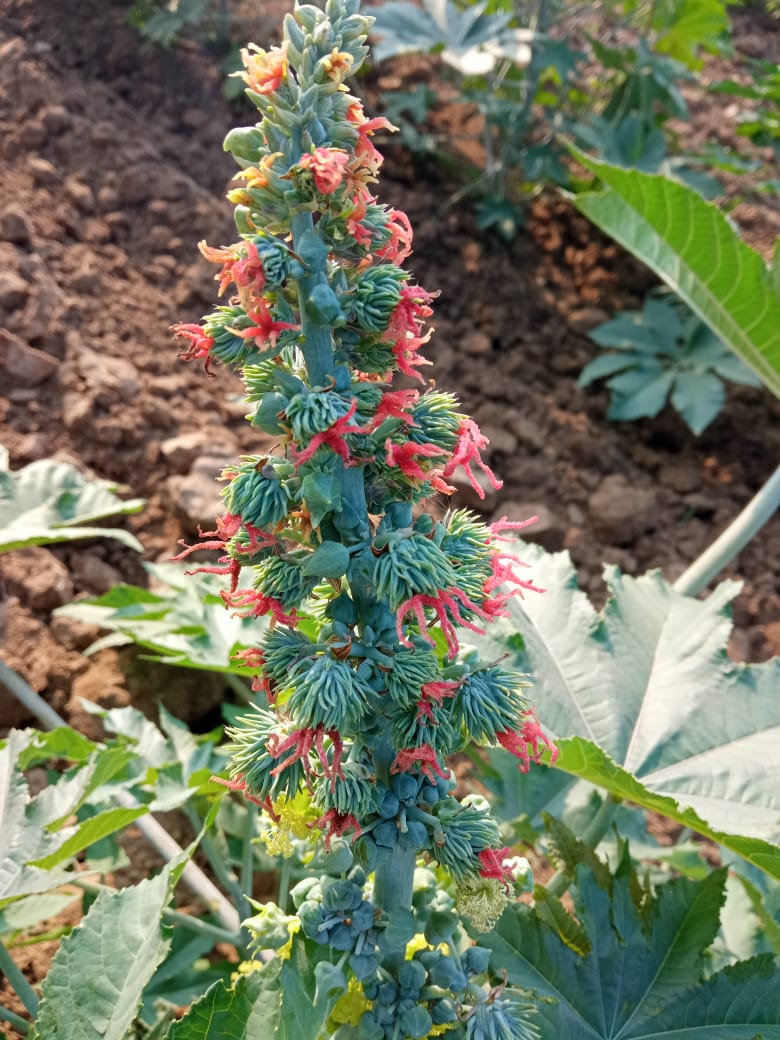
"Grassroots innovations and traditional knowledge are precious resource which provides solutions for various kinds of problems and local needs. A review of SRISTI database suggest that large number of grassroots practices are being used by the farmers in the field conditions to control the termite (OdontotermesobesusRambur) attack. In this study, five plant species being used by grassroots innovators in different forms of preparation for termite control in field conditions were selected for efficacy evaluation. Herbal formulations were developed from the aqueous extracts of twig of Aristolochiabracteata Retz. (Aristolochiaceae), twig of SolanumsurattenseBurm.f. (Solanaceae), leaves of Calotropisprocera Ait. f. (Asclepiadaceae), milky latex of Euphorbia tirucalli L. (Euphorbiaceae) and oil of Ricinuscommunis L. (Euphorbiaceae). Primary screening of the individual extracts, oil and milky latex at 10% concentration shows that C. procera, A. bracteata, R. communis (oil) and E. tirucalli (latex) have significant effects and caused 100% mortality. However, S. surattense caused 88.89% mortality. Compared to the individual treatments, mixture of extracts of C. procera, A. bracteata, S. surattense, oil of R. communis and milky latex of E. tirucalli showed better results in terms of mortality and hence should be preferred for termite control. The results obtained from the experiments are encouraging and proves efficacy of the plants in control of termite. The formulations based on the above plants could be green alternative for the termite control. [Sahay et al, Grassroots solutions for controlling termite attack, JBiopest 7(Supp.):164-169 (2014)]" http://www.jbiopest.com/users/LW8/efiles/vol_7_0_164-169.pdf
|
|
Agro Ecological Zone
|
Eastern Ghats And TamilNadu Uplands And D (8.2),Southern Plateau and Hills Region (X) ,Eastern Dry Zone (KA-5),Tumkur, Bengaluru Rural, Bengaluru Urban, Ramanagara, Kolar, Chikkaballapur
|
|
Other Community Practices
|
E. tirucalli has been used as a fish poison. It is also widely planted as a hedge and for ornamental purposes, especially in dry regions (Nguyen and Sosef, 1999; Orwa et al., 2009). In the West Indies, it is often planted as a hedge plant, potted plant and for dune stabilization (Little et al., 1974). The milky sap is also used as an insecticide and in East-Africa, it is used as gum. The white, close-grained, and fairly hard wood is used for rafters, toys and veneer (Orwa et al., 2009).
|
|
Practice ID
|
DTP0010000002697
|
|
Annotation ID
|
GIAN/GAVL/394
|
|
Reference
|
Lok(4)2, April-1999, pg.no.-9
|
|
Technology Transfer Terms
|
DIY
|