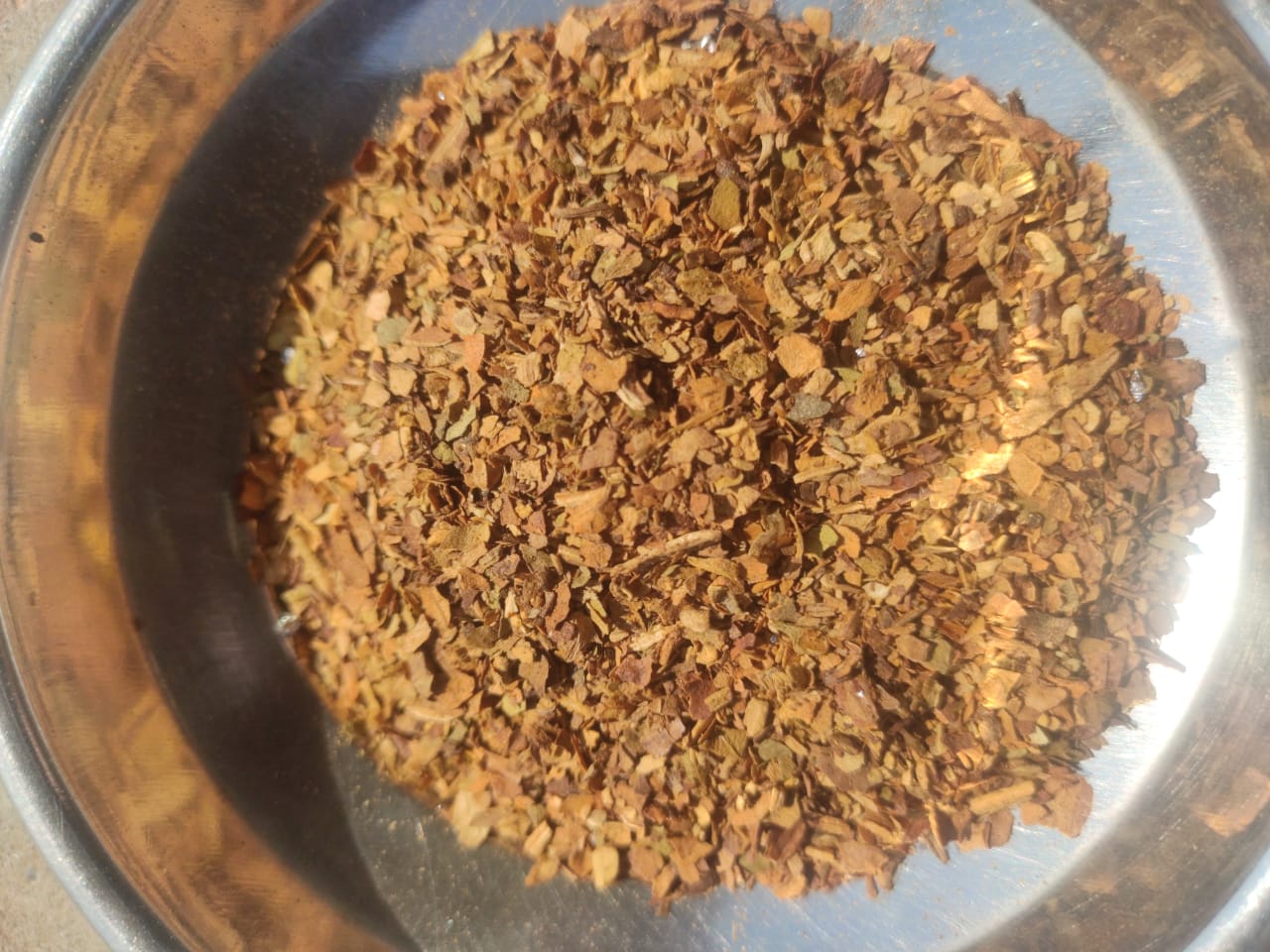
|
PAS 1
|
"Put a thin layer, about 1 1/2 centimetres, of fresh neem leaves in the bottom of whatever container you use to store grain. On top of that, put a layer of sun-dried grain about 30 centimetres thick. Then put in another thin layer of neem, and on top of that another 30 centimetres of grain. Keep on alternating a thin layer of neem leaves with a thicker layer of grain up to the top of the container. Then close it up. Your grain will be safe from insects." [Neem Protects Stored Grain, G. Venkataramani, Agricultural Correspondent, The Hindu, Kasturi Buildings, Anna Salai, Madras ‑ 600 002, INDIA.] http://scripts.farmradio.fm/radio-resource-packs/package-29/neem-protects-stored-grain/#:~:text=Put%20a%20thin%20layer%2C%20about,another%2030%20centimetres%20of%20grain
|
|
PAS 2
|
"Neem (Azadirachta indica A. Juss.) has been demonstrated to reduce insect populations in stored products through its toxic and growth-disrupting and other effects on the pests. Grain movement and percussion also help to kill pests in grain. The combination of neem and grain movement on population growth and development of four insect pests is reported in this study. Dried whole neem leaves, neem leaf powder and neem seed kernel oil were combined individually with dried beans and rice in separate experiments, and subjected to varying degrees of gentle grain tumbling. The results showed that the combined treatments were more effective in reducing populations and disturbing growth and development of Acanthoscelides obtectus (Say) (Bruchidae), Sitophilus oryzae (Linnaeus) (Curculionidae), Oryzaephilus surinamensis (Linnaeus) (Silvanidae) and Cryptolestes ferrugineus (Stephens) (Cucujidae) compared to the untreated control or the neem or tumbling treatments alone. This study demonstrates the potential of a simple, effective and cheap method of protecting stored seed or food grain in small-scale storage for resource-poor farmers who do not have access to sophisticated control methods, entoleters or other mechanical devices for grain protection. [Facknath, S. Combination of neem and physical disturbance for the control of four insect pests of stored products. Int J Trop Insect Sci 26, 16–27 (2006)." https://doi.org/10.1079/IJT200698
|
|
PAS 3
|
"Toxicity of Thevetia peruviana (yellow oleander) against larvae of Anopheles stephensi and Aedes aegypti vectors of malaria and dengue. ABSTRACT: The secondary metabolites (terpenes, acetogenins and alkaloids produced by the plants have been explored for their utility in mosquito control as it has been already proven that some of the plant compounds are toxic to the target organism but harmless to mankind. Basic research for the synthesis of new pesticides is need of the hour. This study was conducted using secondary metabolites of plant extract of Thevetia peruviana to study its larvicidal properties against the larvae of Malaria and Dengue vectors. The toxicity of the leaf extract of Thevetia peruviana was evaluated against the larvae of Anopheles stephensi, and Aedes aegypti mosquitoes. Mean LC50 values of the petroleum ether, chloroform, acetone and methanol extracts obtained from leaves of Thevetia peruviana against the larvae of An.stephensi and Aedes aegypti mosquitoes after 24 hours was determined as 0.045, >0.05, 0.026, 0041 and 0.038, >0.05, 0.021 and 0.036%, respectively. However delayed impact after 3 days with chloroform extract and indicated that the larvicidal action is probably due to the insect growth inhibition." [Yadav, Suresh & Singh, S & Mittal, Pradeep. (2013). Toxicity of Thevetia peruviana (yellow oleander) against larvae of Anopheles stephensi and Aedes aegypti vectors of malaria and dengue.. ] https://www.researchgate.net/publication/261002968_Toxicity_of_Thevetia_peruviana_yellow_oleander_against_larvae_of_Anopheles_stephensi_and_Aedes_aegypti_vectors_of_malaria_and_dengue
|
|
PAS 4
|
"The mosquito Culex quinquefasciatus Say, is the major vector of filariasis, Japanese encephalitis and other plagues throughout the world, especially in the tropical and subtropical countries. For many decades, chemical insecticides have been widely used to control mosquitoes. However, they have developed resistance against these chemical insecticides. Excessive use of such insecticides has also adversely affected the environment. There is an imperative demand to search novel eco-friendly substitutes which are more effective, safe and economical. Plant extracts with proven insecticidal properties are an alternate to these insecticides. The present study describes the larvicidal activity of Annona squamosa plant over the mosquito, C. quinquefasciatus. The average larval mortality percentage after 24 hours of exposure to the ethanolic leaf extract of A. squamosa was recorded as 20%, 30%, 50%, 68% and 100% in respective concentrations of 2 mg/ml, 4 mg/ml, 6 mg/ml, 8 mg/ml and 10 mg/ml. The results of the present study revealed that the ethanolic leaf extracts of A. squamosa plant can be used effectively as a potential, ecofriendly, biodegradable and economic larvicide in integrated mosquito control programme." [Larvicidal efficacy of ethanolic extracts of Annona squamosa (Annonaceae) over the filarial vectors Culex quinquefasciatus Say (Culicidae)https://www.entomoljournal.com/archives/2017/vol5issue1/PartF/5-1-34-185.pdf ]
|
|
Agro Ecological Zone
|
Agro Ecological Sub Region (ICAR) Western Plain, Kachchh And Part Of Kathia ( 2.4, 2.3), Agro-Climatic Zone (Planning Commission) Gujarat Plains & Hills Region (XIII) , Agro Climatic Zone (NARP) North West Zone (GJ-5) North Saurashtra (GJ-6)
|
|
Practice ID
|
DTP0010000002887
|
|
Annotation ID
|
GIAN/GAVL/380
|
|
Reference
|
lok(6)1-2, Jan-Apr-2002, Pg No. 5
|
|
Pest Group
|
chewing
|
|
Pest Scientific Names
|
Prodenia : Spodoptera Heliothis : Heliothis
|
|
Technology Transfer Terms
|
DIY
|