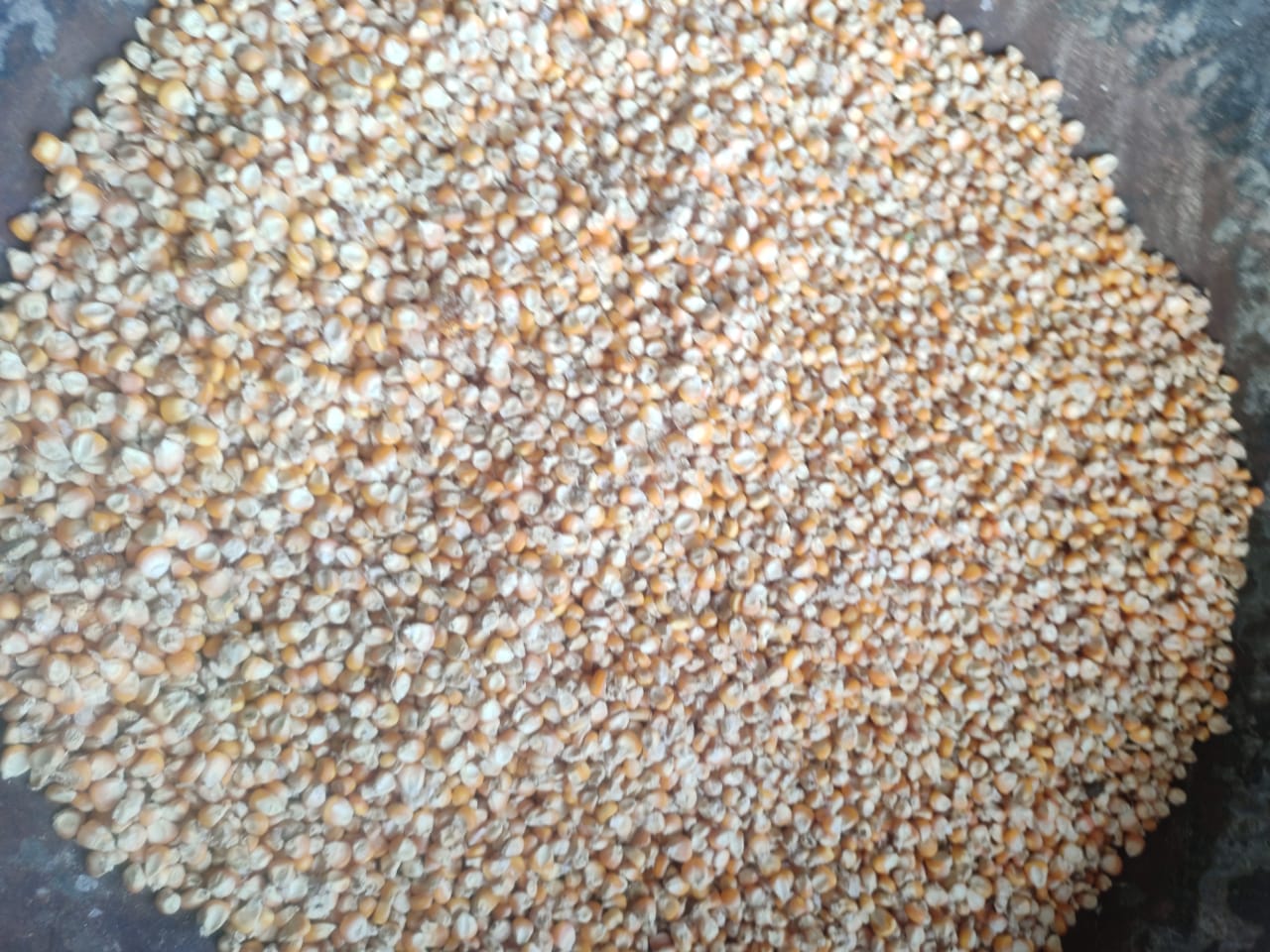
| Category | Crop Pest & Disease Management |
| Crop | Maize |
| Crop Family | Poaceae |
| Scientific Name | (Zea mays) |
| Vernacular Name | bhutta, maize, makka, makai |
| Scout | HBN |
| Ingredients | Leaves of dhumas (Combretum ovalifolium)/ leaves of another plant, ie., keji. |
| Details Of Innovation | Farmers of Valia taluka use a unique method of pest control in maize. Maize is commonly infested by sunga, the local name of an insect pest, which is like a blister bettle, which sucks juice from the pollen of maize plant and ultimately affects the settling of cobs. Infested pollen dries out and fails to fertilize ova. The leaves of dhumas (Combretum ovalifolium) are collected from degraded lands or common lands. Dhumas is a shrub which is found extensively on farm boundaries and waste land in this area. About 5-7 persons stand in a row and keep leaves of this plants in individual bags on their back. They start moving from one side of the field to the other in the direction of the wind. On the way, they catch 1-2 sunga from the air and crush these with 2-3 leaves by rubbing them between the palms of the hands. A peculiar smell comes from the ruptured mixture of leaves and insects. As soon as the smell is removed from the material after 2- minutes, fresh insects and leaves are crushed to replicate the treatment continuously. All insects flee in one direction. This practice is followed collectively to some extent. Farmers from adjoining fields also pursue this practice along with their family members at the same time. All the people start from first field and move in the wind direction. However, about 15 km. away from this place, one farmer Botabhai M. Rajvadiya suggested the use of leaves of another plant ie.keji, instead of Combretum ovalifolium. Keji can be found in hedge and bears small leaves. According to him, 5-7 persons are required for 1 acre of crop. This practice is very common for maize and bajra crops in this area. |
| Innovator / Knowledge Provider | Vasava Rupajibhai Kalibhai 2. Botabhai M. Rajvadiya |
| District | Bharuch |
| KVK District | Krishi Vigyan Kendra, Po-Chaswad, Tq.: Valiya, Distt. Bharuch-393130 |
| Address | Vill:Vagalkhor, Via: Bhilod, Tal:Valiya 2. Vill:Dodvada, Tal: Valiya |
| Languages Spoken | Gujarati |
| Vocation | Farming |
| State | Gujarat |
| PIN Code | 392001 |
| PAS 1 | "Ecofriendmanagement of major pest of Maize in North India."https://www.krishisewa.com/disease-management/315-maize-pests-ne-region.html |
| PAS 2 | "Insect pest management in maize."https://www.daf.qld.gov.au/business-priorities/agriculture/plants/crops-pastures/broadacre-field-crops/insect-pest-management-specific-crops/insect-pest-management-maize |
| PAS 3 | "BIOLOGICAL CONTROL SOLUTIONS FOR CORN PESTS."https://www.rinconvitova.com/bulletins_crop_htm/Corn%20BUL.htm |
| PAS 4 | "ECO FRIENDLY PEST MANAGEMENT STRATEGIES IN ORGANIC FARMING."https://www.researchgate.net/publication/343970655_ECO_FRIENDLY_PEST_MANAGEMENT_STRATEGIES_IN_ORGANIC_FARMING |
| PAS 5 | "Tobacco for pest control in Maize” https://honeybee.org/honeybee_detailed.php?ID=20155&page=6&search_case=caterpillar,%20maize |
| Agro Ecological Zone | Agro Ecological Sub Region (ICAR) Central (Malva ) Highlands, Gujarat Plains and Kathiawar, Peninsula Ecoregion (5.2), Agro-Climatic Zone (Planning Commission) Gujarat plains and hills region (XIII), Agro Climatic Zone (NARP) South Gujarat Zone (GJ-2) |
| Practice ID | KNW0020000000364 |
| Annotation ID | GIAN/GAVL/132 |
| Reference | HBN database |
| Technology Transfer Terms | DIY |

GIAN is the first incubator of grassroots innovations set up in 1997 in collaboration with the Gujarat government and supported by SRISTI and IIMA in addition to the Honey Bee Network.
Registration Nos. –
BPTA (Bombay Public trust Act), 1950 – F/ 5830 (Ahmedabad)
SRA (Societies Registration Act) , 1860 – GUJ/5981/Ahmedabad
FCRA (Foreign Contribution Regulation Act) – 041910244
Bungalow No 1, Satellite Complex, Mansi Cross Roads, Judges Bunglow Rd, Satellite, Ahmedabad, Gujarat -380015
GIAN ©All rights reserved.