15 September 2026 | New Delhi
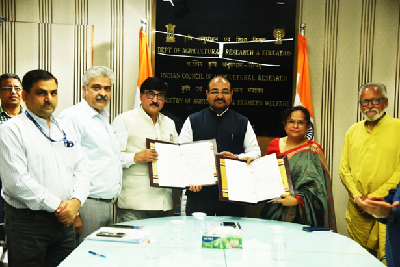
The Indian Council of Agricultural Research (ICAR) has signed a five-year Memorandum of Understanding (MoU) with the Grassroots Innovation Augmentation Network (GIAN) to strengthen the identification, documentation, validation and mainstreaming of grassroots innovations and traditional ecological knowledge in Indian agriculture.
The MoU was signed at Krishi Bhawan, New Delhi, in the presence of Dr M. L. Jat, Secretary, Department of Agricultural Research and Education (DARE) and Director General, ICAR; Dr Rajbir Singh, Deputy Director General (Agricultural Extension), ICAR; Prof. Anil K. Gupta, Vice Chairman, GIAN; Dr Ranjay K. Singh, ADG (Extension), ICAR; Dr R. R. Burman, Assistant Director General (Extension), ICAR; and Dr Anil Kumar, ADG (Tech Coordination), ICAR.
The collaboration provides a structured framework for working with farmers, farm women, rural youth, artisans and other knowledge holders through ICAR’s research and extension network, including Krishi Vigyan Kendras (KVKs).
Key Areas of Collaboration
The five-year partnership will cover several areas related to grassroots innovation, traditional knowledge and sustainable agriculture, including:
- Documentation and mainstreaming of grassroots innovations and traditional knowledge through ICAR institutes and the KVK network.
- Farmers’ innovations for climate resilience, linking grassroots solutions and traditional knowledge with institutional research and programmes.
- RAWE-based Mini-Shodh Yatras and Prayog Yatras to enable students to document local innovations, practices and rural bioresources.
- Sentinel Villages for identifying unmet needs, local resources and grassroots innovations in remote and underdeveloped regions.
- Village Knowledge Registers (VKRs) to document local resources, traditional knowledge and innovations related to agriculture, livestock, natural resources and ethnomedicine.
- Integration of co-created knowledge into agricultural education, including recognition of grassroots innovators and traditional knowledge holders as Professors of Practice.
- Exploration of a Ph.D. programme on “Meeting the Unmet and Unfelt Needs: Inclusive Development through Innovations for and from Grassroots.”
- Promotion of agri-startups and rural technologies through KVK-led frontline extension.
- In-situ agrobiodiversity conservation and inclusive value chains that support benefit-sharing with knowledge-holding communities.
- Exploration of a Global Academy on Grassroots Innovations and Functional Traditional Knowledge.
Ethical and Community-Centred Approach
The collaboration will follow principles of Prior Informed Consent (PIC), fair attribution and benefit-sharing for grassroots innovators and traditional knowledge holders.
These principles are aligned with the Honey Bee Network’s long-standing approach of Recognition, Respect and Reciprocity (3Rs), which emphasises giving appropriate recognition to knowledge holders while ensuring that communities participate in and benefit from the use and development of their knowledge.
“This MoU formalizes a partnership that the Honey Bee Network ecosystem has nurtured for decades — bringing the creativity of India’s grassroots innovators and traditional knowledge holders into the heart of the national agricultural research and extension system.”
— Prof. Anil K. Gupta, GIAN, Honey Bee Network
The activities will be implemented through Joint Working Groups and operationalised through ICAR’s 11 Agricultural Technology Application Research Institutes (ATARIs) and their affiliated KVKs, with coordination by the ICAR Division of Agricultural Extension, New Delhi.
ICAR and Arpan Seva Sansthan MoU
On the same occasion, ICAR also signed an MoU with Arpan Seva Sansthan, Udaipur, Rajasthan.
The collaboration will focus on dissemination of proven agricultural technologies, improved crop varieties and extension support to strengthen agricultural productivity and sustainability.
The partnership will also support capacity-building and skill development in areas including climate-resilient agriculture, natural resource management, watershed development, integrated farming systems and allied sectors.
Farmer–scientist interactions, technology demonstrations, and documentation and dissemination of best practices and success stories will form part of the collaboration.
Strengthening Grassroots Knowledge in Agricultural Systems
The two collaborations will use ICAR’s research and extension network and affiliated KVKs to connect knowledge, innovations and technologies with local agricultural needs.
The ICAR–GIAN partnership provides a formal framework for bringing grassroots innovations and traditional ecological knowledge into agricultural research, education and extension, while creating opportunities for documentation, validation, learning and wider application.
Through this collaboration, farmers, rural communities, innovators, students, researchers and extension institutions can contribute to a more participatory approach to agricultural knowledge and innovation.
About ICAR
The Indian Council of Agricultural Research (ICAR) is the apex body for coordinating, guiding and managing agricultural research and education in India. Established in 1929 and headquartered at Krishi Bhawan, New Delhi, ICAR works through a national network of research institutes, agricultural universities and Krishi Vigyan Kendras.
About GIAN
The Grassroots Innovation Augmentation Network (GIAN) promotes and supports grassroots innovation by working with farmers, students, rural entrepreneurs and other knowledge holders. Rooted in the Honey Bee Network ecosystem, GIAN works on documentation, validation, incubation, intellectual property, product development, enterprise development and the conservation and validation of traditional ecological knowledge.
Related: ICAR – Indian Council of Agricultural Research
Image source: ICAR