
Name and Address:
Shahid Saleem
Lar Ganderbal, Jammu & Kashmir, India
Phone and E-mail:
Phone: +91 7889760399
Email: Shahidsulmani630@gmail.com
Background Information of person / organization:
Shahid Saleem is researcher and practitioner from the Gujjar-Bakarwal pastoral community of Jammu & Kashmir, India. He holds a Master’s degree in Geography and a Postgraduate Diploma in Disaster Management, and Ph.D. on pastoralism and climate change. He is the founder of the Himalayan Pastoral Trust, Led flagship initiatives including the Alpine Pond Project, a nature-based intervention addressing climate-induced water scarcity and pastoral displacement, aimed at strengthening water security and adaptive capacity in high-altitude Himalayan rangelands and community-driven Grassland Restoration through, invasive species management, and the creation of community-based fodder storage systems to buffer seasonal shortages aimed at strengthening, ecosystem integrity, and livelihood security, while reversing the rapid decline of pastoralism in Himalayan landscapes.
Challenges & Problems faced in Rangeland and Pastoralism:
Water scarcity in high-altitude pastures has emerged as one of the most severe and immediate challenges facing transhumant pastoralists in the Kashmir Himalayas. During seasonal migrations, families carry only the bare essentials and lack the means to store even 100 liters of water. They are entirely dependent on natural springs for drinking, cooking, and meeting livestock needs.
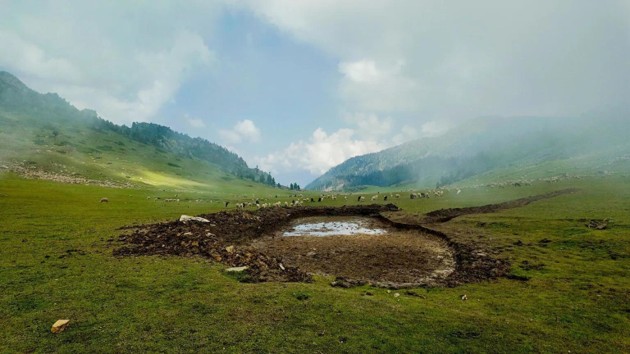
Climate change has made this dependence increasingly precarious. Reduced snow accumulation during winter, early snowmelt, and prolonged summer droughts have led to a widespread decline in spring discharge. Many traditional water sources now dry up weeks before the end of the grazing season. When a spring fails, pastoral families often struggle to find enough water even to prepare daily meals.
This scarcity places a disproportionate burden on women and children, who are usually responsible for water collection. Long, physically exhausting journeys across rugged alpine terrain become unavoidable. In extreme cases, entire families are forced to move their herds prematurely in search of water, abandoning traditional pastures that have sustained them for generations.
Such forced movements result in what pastoralists describe as distress migration. These are not planned seasonal transitions but emergency relocations driven by water stress. Distress migration disrupts grazing calendars, increases livestock mortality, accelerates pasture degradation in receiving areas, and erodes pastoral knowledge systems tied to specific landscapes. Over time, repeated water crises contribute to the rapid decline of pastoralism as a viable livelihood, pushing younger generations away from herding and weakening intergenerational transmission of ecological knowledge.
Role and Achievements in Rangeland management and related development:
The rangeland restoration work is carried in the high-altitude alpine and sub-alpine grazing landscapes of the Kashmir Himalaya, particularly across Ganderbal and Bandipora districts of Jammu & Kashmir. These seasonal pastures, locally known as “margs,” are traditionally used by transhumant Chopan, Pahadi, and Gujjar Bakarwal pastoralists during summer migration. Functioning as common property resources, these rangelands are governed through customary pastoral institutions, although administratively they fall under forest and revenue department jurisdictions. Historically, their sustainability depended on mobility, rotational grazing, and indigenous ecological knowledge. However, recent climate variability manifested through declining snowfall, erratic precipitation, and mid-season drying of springs has disrupted these systems, leading to pasture degradation and uneven grazing pressure, as identified through field-based assessments and community consultations.
Geographical Coverage and Area of Intervention
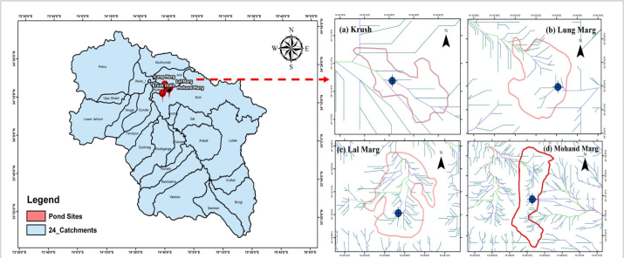
The intervention spans multiple high-altitude grazing sites (See Map), including Tragbal (2720 m), Lal Marg (3229 m), Mohand Marg (3351 m), Maalie (2475 m), and Grattwattan (3450 m). These ecologically fragile landscapes are highly sensitive to climatic changes, with visible impacts on moisture regimes, vegetation stability, and water availability. Through improved water access and redistribution of grazing pressure, the initiative has influenced approximately 400–500 hectares of grazing land, contributing to better ecological balance and pasture utilization.
Intervention Approach and Role in Restoration
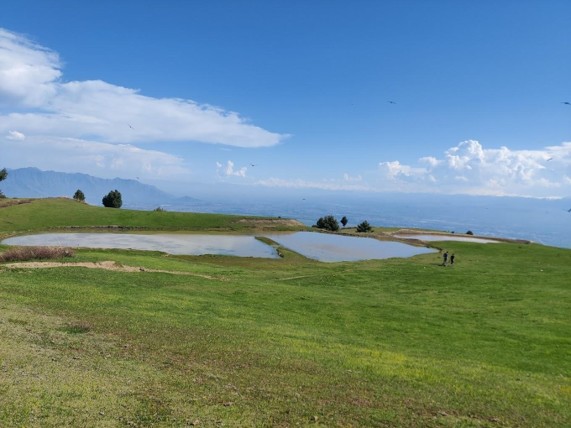
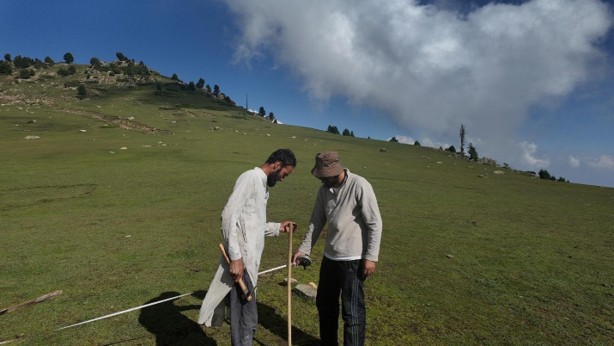
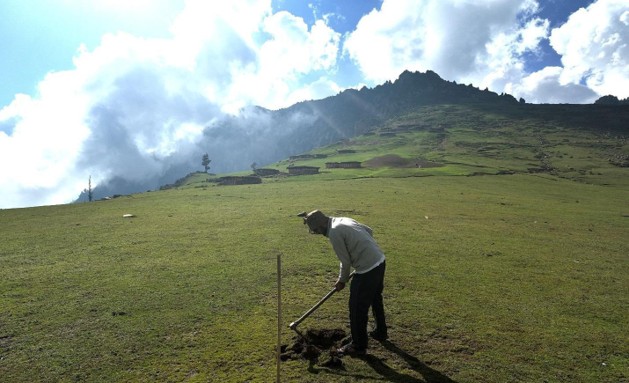
To address the critical issue of water scarcity in alpine rangelands, Himalayan pastoral trust initiated the Alpine Pond Solution, a community-led, nature-based intervention focused on creating decentralized water systems within grazing landscapes. The initiative involves the construction of small rainwater and snowmelt harvesting ponds strategically located along migratory routes. Site selection is guided by a combination of geospatial tools such as NDVI-based grassland assessment, Digital Elevation Models, and stream-order analysis, alongside traditional pastoral knowledge related to seasonal water flow, grazing patterns, and carrying capacity. This integrated approach ensures that ponds are constructed in low-pressure or underutilized grazing zones, thereby redistributing livestock movement and reducing ecological stress on degraded pasture areas.
Livestock, Biodiversity, and Ecological Impact:
The initiative currently supports over 20,000 livestock, including sheep, goats, cattle, and horses, which depend on seasonal alpine pastures for survival. In the long term, the model has the potential to benefit up to 3 lakh livestock across expanded grazing networks. The intervention also supports biodiversity by creating micro-water habitats used by birds, small mammals, and other wildlife species in otherwise water-scarce environments. By reducing livestock concentration around a few remaining springs, the initiative minimizes soil erosion, vegetation loss, and localized degradation, while enabling natural regeneration of pastureland and improving soil moisture retention.
Community Beneficiaries and Livelihood Outcomes
The initiative has directly benefitted approximately 500–550 pastoral households, representing around 3,500–4,000 individuals across multiple grazing sites. Additionally, nearly 200 pastoral households benefit indirectly as they use these areas as transit points during migration. Reliable water access within grazing landscapes has significantly reduced the burden of water collection, particularly for women and youth, while improving livestock health and reducing mortality risks. This has strengthened livelihood security and enabled pastoral families to continue seasonal migration with greater confidence under changing climatic conditions.
Governance and Management of Resources
A key strength of the initiative lies in its community-led governance model. Pastoral communities are actively involved in identifying locations, constructing ponds, and managing their use. Informal rules have been developed for equitable access to water, seasonal cleaning, and protection of shared resources. Collective decision-making processes, rooted in traditional pastoral institutions, ensure sustainable use of commons. Participation of elders, women, and youth has strengthened stewardship and reinforced community responsibility towards long-term rangeland conservation.
Policy Linkages and Institutional Engagement
Although primarily a grassroots initiative, the work has begun to influence broader institutional processes. The model has been shared with government departments, with permissions facilitated through collaboration with the Forest Department. It has been recognized as a climate adaptation practice and documented as a best practice within emerging global frameworks related to nature-based solutions and rangeland restoration. The initiative demonstrates strong alignment with climate adaptation goals and sustainable land management priorities.
Key Achievements and Impact
The initiative has led to significant improvements in rangeland health and pastoral resilience. Redistribution of grazing pressure has reduced localized degradation and supported pasture regeneration. Water availability in previously dry areas has enhanced ecosystem stability and reduced dependence on vulnerable natural springs. Livelihood outcomes include improved livestock productivity, reduced labour burden, and decreased climate-induced stress on pastoral systems. Ecologically, the ponds contribute to soil moisture retention, groundwater recharge, and biodiversity support, strengthening the overall resilience of alpine rangelands.
Innovation and Replicability
The initiative represents a unique integration of indigenous pastoral knowledge with scientific tools and low-cost ecological design. By using water as an entry point for rangeland restoration, it addresses interconnected challenges of climate change, land degradation, and livelihood vulnerability. With an estimated cost of ₹70–80 per beneficiary and reliance on local materials and community labour, the model is highly cost-effective, scalable, and replicable across similar Himalayan and mountain pastoral systems.
Key innovative aspects of the Alpine Pond Solution include:
- Stage 1: Classification of pasture based on vegetation health using NDVI (Normalized Difference Vegetation Index) derived from satellite imagery.
- Stage 2: Estimation of stocking rate and carrying capacity of the pasture using field data.
- Stage 3: Preparation of grazing plans with the community through community policing and youth clubs, aligning grazing practices with the estimated carrying capacity.
- Stage 4: Identification of suitable alpine pond sites using stream order analysis derived from a DEM (Digital Elevation Model).
- Stage 5: Construction of alpine ponds and redistribution of herds from high grazing pressure areas to surplus grazing areas.
The Pond Solution demonstrates that community-led, low-cost interventions can generate transformative impacts in fragile mountain ecosystems. By improving water security, strengthening commons governance, redistributing grazing pressure, and enhancing climate resilience, the initiative contributes to sustainable rangeland restoration while securing pastoral livelihoods. It offers a practical and scalable model for climate-resilient pastoralism in high-altitude regions where ecological sustainability and community well-being are deeply interconnected.
Impact and Feedback:
Community feedback on the Alpine Pond Solution has been highly positive. Pastoral households report improved water availability within grazing areas, reducing dependence on distant and drying natural springs and improving livestock health and stability. Women and youth have particularly benefited from reduced time and effort in accessing water.
Importantly, strong community ownership is reflected in the fact that pastoral groups have partnered with the Himalayan Pastoral Trust to construct 7 additional alpine ponds in upcoming migration 2026 season, through a 50% cost-sharing model, demonstrating trust and willingness to invest in the solution. Community members have also observed better grazing distribution, reduced pressure on fragile pastures, and early signs of ecological recovery, while actively participating in maintenance and governance
What are the future plans or opportunities for strengthening your work on rangeland restoration and pastoralism:
The initiative aims to scale up the Alpine Pond Solution across more high-altitude grazing areas facing water scarcity, based on strong community demand. Future plans include constructing additional ponds along migratory routes, strengthening community-led governance, and expanding the cost-sharing model to enhance local ownership. There is also a focus on integrating scientific monitoring (e.g., grazing pressure and carrying capacity) and documenting traditional knowledge through education initiatives. Efforts will be made to engage with government agencies to support policy integration and replication of this model across other Himalayan pastoral regions.
Photos and Videos:
Link of Video Youtube: https://youtu.be/7gx9a5BBKwQ