Name and Address:
Joe, Eileen and William Condon
Clashavaugha, Ballymacarbry, Clonmel, Co. Tipperary, Ireland, E91A409.
Phone and E-mail:
Phone: 00353872735447/ 00353872903935
Email: omegabeefdirect@gmail.com
Background Information of person / organization:
Joe (aged 66) is a full-time farmer. He has a Level 6 Certificate in Field Ecology from University College, Cork, Ireland. He has spent many years promoting rangeland livestock production in Ireland. He was a mentor for a Department of Agriculture- funded project entitled “Organics with Altitude”. He has been a mentor with the Horse’s Mouth initiative for Farming for Nature www.farmingfornature.ie. He is a member of Irish Natural Hill Farmers Association (INHFA) and advises on policy at a national level.
- Eileen (aged 65) is also farming full-time. She has also worked in adult education where she organised digital literacy classes specifically for farmers.
- William, our son, is 35. He holds a Level 6 Certificate in Farming awarded by Quality and Qualifications Ireland ( QQI). QQI is the state agency responsible for promoting the quality, integrity and reputation of Ireland’s further and higher education system.
- We are members of the Irish Organic Association (IOA), and the Irish Farmers Association (IFA)
- We were pioneers in setting up Farmers’ Markets in South Tipperary, where we sold our hill-grazed beef direct to customers.
- In 2006, we developed our website www.omegabeefdirect.ie where we still sell our meat direct.
- We are members of the Urban Co-op in Limerick, Ireland, where our hill-grazed beef is sold. This Co-op provides a direct sales outlet to farmers and their produce www.theurbanco-op.ie
- We are clients of Teagasc, the national body of providing integrated research, advisory and training services to the agriculture and food industry and rural communities in Ireland. ( see Advisor testimonial in Section 7)
- We have just completed a five-year farm research pilot for the National Parks and Wildlife Service (NPWS) entitled “Upland Grazing Through Precision Livestock Farming”.
- We have been recognised by various groups over the years for our farming practices and beef, which shows rangeland-based livestock production can make a significant contribution to environmental sustainability and food security.
Challenges & Problems faced in Rangeland and Pastoralism:
The main challenge for us is under -utilisation of cattle grazing on commonage lands.
Expansive upland sites typically have one or more areas that are not adequately grazed by stock. The habitat soon deteriorates, as does available forage. In the absence of adequate cattle grazing, certain species have a competitive edge and soon take over to the detriment of other species, leading to decreased biodiversity. This can have negative implications for associated fauna, such as pollinators, birds, grouse, and hares. Purple moor-grass (molinia caerulea) bracken (pteridium aquilinum), soft rush (juncus effuses) and European gorse (ulex europaeus) are good examples of species that can become problematic in rangeland with an absence of cattle grazing.
Lack of physical fencing on commonage presents challenges to livestock grazing these lands to help restore the ecosystem balance and contribute to food security. These challenges are not insurmountable, as we have had the opportunity to show in our research pilot with the National Parks and Wildlife Service. (outlined in Section 6).
The genetic traits of the cattle suitable for rangeland grazing need careful selection. The current preference for breeds that are more suitable for large intensive farms can influence the lack of availability of more traditional breeds that are required and best suited to rangeland livestock production. The more “modern” breeds tend to graze individually in these landscapes, and not as a herd.
The challenge for rangeland livestock farmers is to re-boot grazing as a herd through a stockmanship concept known as “instinctive migratory grazing.” This is something we plan to progress.
Role and Achievements in Rangeland management and related development:
Our rangeland farm is located in the Knockmealdown Mountains, near the village of Newcastle, near the town of Clonmel, in South Tipperary, Ireland.
We graze 50 acres of privately- owned semi-natural permanent grassland as well as a privately owned share of hill commonage, which spans over 2,5000 acres. The species of grass on the commonage is a combination of heather, species-rich grassland, sphagnum mosses, and heath, all defined as permanent grassland established under local practices. Our farm is certified organic since the year 2000.
We are beef suckler farmers and currently have a herd of 60 cattle. When we acquired our farm in 1997, we studied the land in great detail. We understood the best way forward was to choose breeds that suited this rangeland farm, rather than try to manipulate the land to suit larger continental cattle, which would have required high inputs such as fertiliser, extra feed and extra sheds. Thus, our rangeland farming experience began by researching the best breeds of cattle for grazing these environments. We decided to use Galloway cattle based on their ability to graze extensive rangeland. Their double coat of hair insulates them from the cold and wet and their barrel –shaped body and short legs enable them to have good balance on the hilly ground. Their physical conformation and their extensive grazing habits also protects the land from poaching. These livestock prefer being outdoors, and, as a result, their fitness level contributes to easy calving. We have had no need for veterinary assistance for calving since we began farming. Our rangeland based livestock production grazing system utilises the best principles of mobile pastoralists. This type of farming has a long history in Ireland in the uplands, and was referred to as “booleying” where livestock would be moved to graze the commonage land in the summer months. We continue this practice and this allows us to rest our private enclosed land in the summer. As well as being economically advantageous, this grazing practice has benefitted our land tremendously. Our recent participation in the Department of Agriculture Agri-Climate Rural Environment Scheme (ACRES) has shown positive results. Farmers are scored on their environmental outcomes using scorecards. The higher the score (representing better biodiversity and habitat quality), the higher the payment. We have achieved and maintained very high scores. The measures we have chosen in ACRES includes maintaining old stone walls, which serve as shelter for a variety of insects and plants, and leaving a margin within fields undisturbed. We also chose the option to support Rare Breeds of cattle that are native to Ireland. We have pedigree Irish Moiled cattle, rare native Irish cattle breeds, as well as the Galloways who are part of our rangeland grazing.
In 2020, we began a research pilot with the National Parks and Wildlife Service. Our idea was to use targeted precision grazing to gain access to commonage land that was not being grazed by cattle, and by utilising our Galloways to graze these areas, these areas could have their environments restored. We submitted our proposal and were given a five- year Farm Plan based by the NPWS to pilot this idea. As mentioned, commonage land is not physically fenced when ownership is shared and plots are remote. Our proposal involved using virtual fencing. This involves the cattle wearing collars that respond to a “pulse” felt around their neck. This is transmitted to the animal when it gets close to the virtual boundary in a paddock created on an App on our mobile phone. The pulse takes the form of musical notes that ping off a satellite which the animal hears and feels if the animal gets near the boundary. The batteries in the collars are charged manually first, and then recharged by the sun while the livestock graze. This project was a collaboration between an ecologist sent by NPWS and ourselves. The ecologist chose the areas on the rangeland that were under-grazed and we trained the cattle to respond to the virtual fence and herded them to the designated areas on the commonage.
Our livestock were deployed for the remedial management of mature ling heather (Calluna vulgaris) on dry siliceous heath. Prolonged trampling, grazing and dunging stimulated the growth of new heather, and the emergence of new species, thus having positive outcomes to biodiversity, and increasing overall palatability of these areas. Species benefiting from the grazing of this rangeland includes, pheasants, grouse, hares, and birds, such as Lapwings, Hen Harriers, Buzzards, and Meadow Pippits, as well as butterflies and pollinators, not to mention the increase of plant biodiversity. Reducing ling cover has allowed for the emergence of new species and the increased cover of existing species such as Tormentil (Potentilla erecta) along with grass and sedge species.
This pilot was also about trialling safe and effective means of heather control without having to resort to burning.
Our rangeland grazing practices also utilise under-grazed land for the purposes of promoting a market for a conservation-grazed beef product to consumers, thus ensuring the agricultural viability of this type of land, while also contributing to global food security.
While the main type of rangeland grazing in this location is carried out by sheep, we chose to introduce cattle and this resulted in us developing a beef product that is grass-fed and grass-finished, and conservation-grazed, which is a bonus for consumers who value these properties in their food. We are one of the farms in Ireland that provided beef samples to research conducted by Teagasc and University College, Dublin that seeks to create simple markers that validate that beef is Irish and grass-fed, which is known to contain elevated levels of nutritionally-beneficial nutrients (e.g. omega 3 fatty acids, conjugated linoleic acid); and that can be produced in low input, environmentally-sustainable farming systems; and is attractive to consumers who are increasingly aware of the origin of their food and the manner in which it has been produced. By selling direct on our website, www.omegabeefdirect.ie we have given people access to meat produced on rangelands, and educated them about how livestock grazing can improve the biodiversity of the land. We have given business to local shops who stock our beef. We have given additional business to a local butcher who butchers our cattle. We would like to develop “conservation-grazed” as a quality descriptor of beef produced in a way that benefits the environment. We believe that there is great potential for this. By grazing the commonage, we have also improved the landscape. Our cattle have been successful foot soldiers for the environment, grazing species not favoured by the sheep. We can notice the difference on the rangeland when the cattle have grazed versus no grazing. We are very interested in showing that increasing biodiversity is not about zero grazing, especially in areas where certain plant species take over. Our livestock practices earned us a National Organic Award in 2009, one of the Farming Ambassador Awards in 2019 by Farming for Nature, www.farmingfornature.ie.
By hosting farm walks in recent times we have helped instigate a policy change in livestock production. Cattle grazing the uplands had become virtually non-existent, but by showing other farmers how they can use their marginal hill land to benefit the environment and develop good food products, we believe we have made a positive impact.
Feedback from community members/public:
- 2009 Award finalist in Small Firms Association Environmental Sustainability Category (see attached)
- 2009 National Organic Awards, sponsored by Irish Food Board, Bord Bia, Achieves Highly Commended in Best Organic Sustainable Product Category
- 2010 Environmental Award winner by the Irish Food Writers Guild for producing beef, from mountain to marketplace, using farming methods that are a model of sustainability. The aim of the Irish Food Writers Guild is to highlight and influence food policy; and to create debate on sustainable and ethical food production, to promote Irish food at home and abroad. Irish Food Writers’ Guild – Good Food Awards
- We were awarded a Farming Ambassador Award in 2019 by Farming for Nature, www.farmingfornature.ie for our cattle rangeland grazing practices that directly contribute to enhanced environmental sustainability and food security. as well as rural sustainability for young farmers and local businesses.
- Our rangeland produced beef has been given good reviews by notable chefs and food critics. These reviews are on the Home Page of our website www.omegabeefdirect.ie
What are the future plans or opportunities for strengthening your work on rangeland restoration and pastoralism:
We hope to start a new five- year Farm Plan with NPWS encouraging the instinctive migratory grazing instinct in cattle. This is with a view of increasing cattle livestock production on areas of the commonage, and establishing conservation-grazed as a unique selling point for products emanating from this type of rangeland grazing.
We are currently involved in a project with a group called ReFarm. This project is unique in that its funders are people in private business who believe in using their money in ways to support improving biodiversity.
We have been asked by the NPWS to contribute to be part of a working group that is producing a Conservation Grazing Manual. This project has just started.
Our son, Will, is very interested in making videos and has a flair for narrating so this can be a powerful way to spread the word, especially to younger generations of farmers. He has already started this in an informal way and he is getting great feedback. Using technology in this way can have a global reach for creating greater awareness and appreciation of rangeland-based livestock production as a powerful contributor to food security, ecosystem balance, climate change adaptation and mitigation, environmental sustainability, and rural sustainable development.
Photos and Videos:
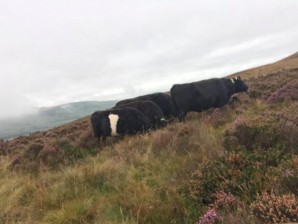
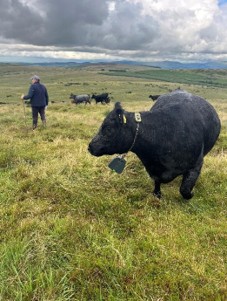
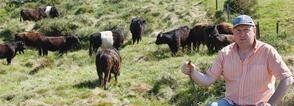
Checking the herd in area of targeted grazing.
It’s always important to physically check on the animals and not rely only on phone App Herd grazing remote under-grazed commonage using virtual fencing. Foot soldiers for the environment.
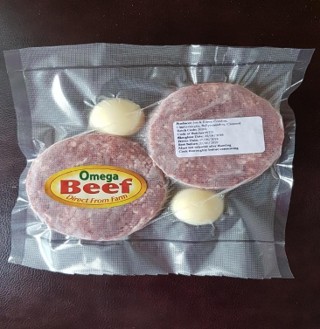
Our grass-fed conservation grazed burgers with “buttons” made from the tallow sold direct.
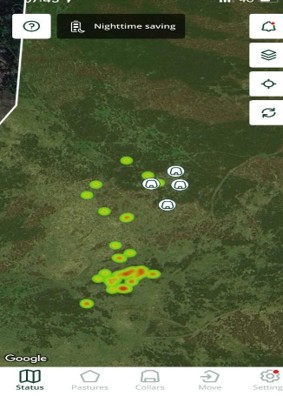
An image of virtual fencing from App on mobile phone. The white dots show where the cattle with the collars are in real time. The green and red represent areas grazed by the cattle that within the virtual paddock that day. All of this information is conveyed on screen of phone.
Click on video below and you will see us: Our network of Ambassadors – Farming for Nature
Reference of two known person/ leaders / Government:
1. Barry O’Donohue, Scientific Advice and Research, National Parks and Wildlife Service, 90 King Street North, Dublin 7, D07 N7CV, Ireland
Email: Barry.ODonohue@housing.gov.ie
Phone: 00353879110715
2. Orla Walsh, Advisor, Teagasc Farm Advisory Services, Clonmel, Co. Tipperary, Ireland.
Email: Orla.Walsh@teagasc.ie
Phone: 00353526121300
Eileen, Joe and Will Condon are exemplary Organic farmers, farming 50-acres of enclosed farmland along with 1000 acres of commonage in the Knockmealdown Mountains, Co. Tipperary. They keep a herd of Belted Galloways and Galloways which are 100% grass fed and organic. They chose these cattle because they are well suited to upland conditions, can remain outdoors year-round, and can positively impact their environment by controlling invasive species. They sell directly to customers and are a strong example of farmers managing commonage ecologically, with their cattle kept outdoors for all 12 months of the year. The cattle are well adapted to thrive on the naturally abundant hill forage, making the enterprise both practical and forward-thinking. Simplicity lies at the heart of the Condon’s farming approach, with a low-input system that delivers both economic and environmental benefits.
The final product is marketed and sold directly to consumers under the Omega Beef Direct brand and is stocked in a selection of local shops. Selling directly has strengthened the farm’s position within the food chain, allowing the business to become a price maker rather than a price taker.
The system also demonstrates the value of low food miles: animals are butchered within 8 kilometres of the farm, while the burgers feature on the menu of an award-winning café located just 6 kilometres away. The Condon’s farming system offers both locals and visitors the opportunity to taste and enjoy food that is genuinely produced in harmony with nature and rooted in the local landscape, while also enhancing a sense of food security, connection, and satisfaction.
As participants in the Agri-Climate Rural Environment Scheme (ACRES), each year of scoring their Low Input Grassland (LIG) paddocks achieve top marks, reflecting the excellent pasture management this results-based measure is getting by the Condon’s. The purpose of LIG under the ACRES is to reward farmers for farming grassland extensively which maximises the other services the field provides to nature, water quality and climate. The scheme is currently in its 4th year of a 5-year tranche, and the Condon’s have managed to maintain their high score and in doing so, have become a model example of what Low Input Grassland should be and the simultaneous benefits such diverse swards have for biodiversity, water quality and overall environmental sustainability.
The trio create a strong family farming partnership that reflects both positivity and a deep commitment to sustainable farming practices. They exemplify the many benefits of rangeland-based livestock production and mobile pastoralism, contributing to food security, ecosystem balance, climate change adaptation and mitigation, environmental sustainability, and resilient rural development. What some may view as a disadvantage farming in upland areas and on commonage, the Condon’s see as an opportunity. They recognise the potential and unique benefits this farming system can provide and have successfully adapted their enterprise to work in harmony with the landscape, turning challenging terrain into a sustainable and productive advantage. Seeing first-hand how the Condon’s are managing their system and farming with nature, it is a pleasure to be able to work with them, as they personify environmental stewardship and restoration and management of uplands.