Name and Address:
Bold-Erdene Punsaldeleg
Bayanbulag bag, Bulgan soum, Arkhangai Province, Mongolia
Phone and E-mail:
Phone: +976 90079095
Email: khoidmogoingolteelucc@gmail.com
Brief Background Information of Nominee:
Mr. Bold-Erdene Punsaldeleg — known among his community as Boldoo — is a 51-year-old herder from Bulgan soum, Arkhangai Province, Mongolia. Having completed his secondary education in Bulgan soum in 1991, he dedicated himself entirely to traditional livestock herding, a way of life he has practiced without interruption for 35 years, preserving and passing on the nomadic heritage and cultural traditions of Mongolia. In 2026, his outstanding leadership in community-based conservation of the mountain forest-steppe ecosystem was formally recognized by local authorities, who named him the best CBO leader in Bulgan soum.
Challenges & Problems faced in Rangeland and Pastoralism in your area/region:
The Khoid Mogoitin Gol Teel (KMGT) forest-steppe ecosystem in Arkhangai province covers 137,018 hectares of mountain forest-steppe landscape — one of the largest remaining intact temperate grasslands in the world. This is the land where Boldoo and over 400 herder households have lived for generations.
Until around 2018, this landscape was under serious threat. Herder communities of Bulgan soum witnessed rapid degradation driven by illegal hunting, uncontrolled timber logging, overgrazing, pastureland deterioration, and deforestation. Iconic and globally threatened wildlife — the Saker falcon (Mongolia’s national bird), Steppe eagle, Siberian marmot, and Musk deer — all carrying deep cultural meaning for local communities, were declining sharply due to uncontrolled economic overexploitation.
At that time, over 400 herder households in the KMGT area were unorganized, and some community members were themselves engaged in illegal hunting, timber logging, and cedar nut harvesting, driven largely by poverty and lack of alternative livelihoods. As ecosystem degradation escalated, herder livelihoods became increasingly precarious, resilience to climate change weakened, and communities — particularly women — faced deepening poverty and inequality.
It was in this context that Boldoo stepped forward, recognizing that without strong community organization and collective action, this critical forest-steppe ecosystem — and the traditional nomadic way of life that depends on it — faced irreversible loss.
Role and Achievements in Rangeland Management/Restoration:
From Herder to Conservation Leader
Boldoo began his conservation journey as the elected leader of the Bayanbulag CBO, one of the founding member CBOs of the UCC managing the KMGT LPA. Through his practical wisdom, credibility as a lifelong herder, and tangible results on the ground, he earned the trust of fellow herder communities across the LPA. In 2022, he was elected Board Director of the UCC — a recognition of his outstanding leadership by over 350 herder households across all CBOs.
Expanding the Protected Area and Growing the Community Movement
One of the most significant achievements under Boldoo’s stewardship has been the expansion of the LPA from its original 137,018 hectares to over 242,000 hectares. This was not driven by government decree — rather, Boldoo and fellow CBO leaders personally influenced non-member herders in neighboring areas, inspiring them to organize their own CBOs and join the LPA movement. Member CBOs grew from 10 to 20, with total membership reaching 599 herders across 351 households. The expanded LPA boundary was subsequently formally approved by the Government of Mongolia, a testament to the legitimacy and credibility of the community-led process that Boldoo championed.
Wildlife Recovery and SMART Patrolling
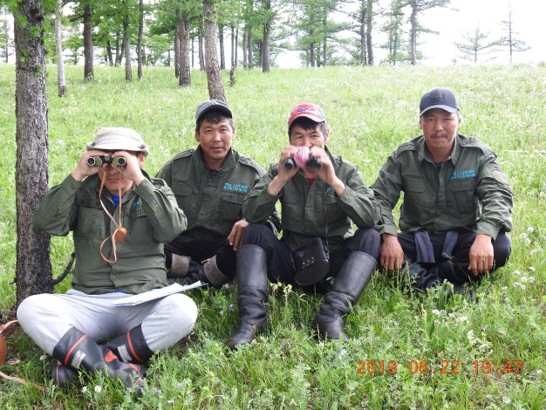
Community-based SMART patrolling became a cornerstone of LPA management under Boldoo’s leadership — an innovation in Mongolia where such tools had previously been used only by employed government rangers. Forty Volunteer Rangers (VRs) were trained and conducted SMART patrols 297 times, averaging 12 patrols per month. Working alongside the Arkhangai Community Stewardship Support Group (CSSG) — bringing together nine local government institutions including the Ecological Police Division and Environment & Tourism Department — these efforts resulted in zero poaching recorded across the LPA.
Biodiversity monitoring results by 2021 since CBO/LPA establishment demonstrated remarkable recovery: the Siberian marmot population increased by 36%, Saker falcon by 21.4%, Steppe eagle by 38.1%, and Musk deer by 25% — all species of profound cultural significance to Mongolian nomadic communities.
Forest and Rangeland Management
Bayanbulag CBO was among the most active in implementing Forest and Rangeland Management Plans. The CBO planted forage species across 10 hectares and fenced winter grazing sections to preserve pastureland. Annual forest cleaning became a tradition under UCC leadership — each year, UCC members clean 10 hectares of forest, transport timber to local markets, sell it at a 50% discount, and donate a portion to support poor families. Income from forest cleaning benefited a growing number of households: 32 in 2021, 52 in 2022, and 70 in 2023, with average income increases of around 500,000–600,000 MNT per participating household.
Pasture management plans were developed participatorily with 102 herders, and CBOs fenced critical springs and rested winter grazing areas during summer to maintain rangeland health. While broader challenges including climate variability and market pressures made significant rangeland improvement difficult, degradation was halted — itself a meaningful achievement in this landscape.
Livelihoods and Community Wellbeing
Under governance structures that Boldoo helped establish and now leads as Board Director, CBOs developed the “Shine Bulgan Sor” livestock cooperative to diversify incomes and improve market access. Village Savings and Loan Associations (VSLAs) expanded significantly, with 83.4% of community members participating and 85.6% accessing affordable loans. While the multidimensional poverty index faced upward pressure due to harsh dzud winters in 2023 — when LPA herders lost approximately 15% of their livestock — and the lingering effects of COVID-19, the VSLA safety net and cooperative income helped communities absorb these shocks and maintain resilience.
Empowering Women in Conservation
Boldoo is a strong and active champion of gender equality within the LPA. He consistently supports female CBO members, seeks opportunities to amplify their voices, and enables their participation in national and international forums. Under his leadership, women hold 100% of seats on the LPA Monitoring Council and represent 40% of all training participants.
His commitment goes beyond governance structures. In 2025, Bayanbulag CBO member Mrs. Odongerel participated in the International Rangeland Congress (IRC) in Adelaide, Australia, delivering a keynote speech jointly with Dr. Tungalag Ulambayar, Director of Zoological Society Luujin. In May 2026, Mrs. Ariuntuya Damba, leader of Bayanzurkh CBO, participated in the Global Gathering of Pastoralist Women in Kathmandu, Nepal — bringing the voice of Mongolian herder women to a global stage.
Governance and Institutional Legacy
As Board Director, Boldoo chairs a democratic governance structure in which all 20 CBOs participate in collective decision-making, in active partnership with the CSSG and government bodies at soum, aimag, and national levels. The LPA management model has been recognized nationally, with the Ministry of Environment inviting its replication in Gobi-Altai and Zavkhan provinces, and published as “Local Protected Area Management Model in Mongolia: A case of Khoid Mogoin Gol Teel LPA” for wider sharing with conservation practitioners.
By end of 2023, 70.4% of community members reported improvement in natural resource protection and sustainable use — a 15.4% increase from baseline — reflecting the profound shift in community values and behavior that Boldoo’s leadership helped inspire.
Feedback from Community Members/Public:
Fellow herders and UCC members across the LPA consistently highlight two qualities that define Boldoo’s leadership: his genuine warmth as a person, and his uncompromising insistence on rules and collective discipline.
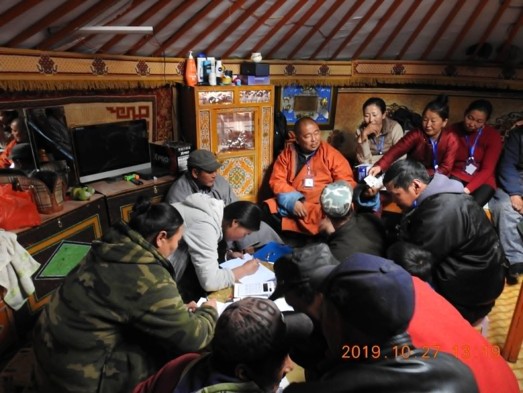
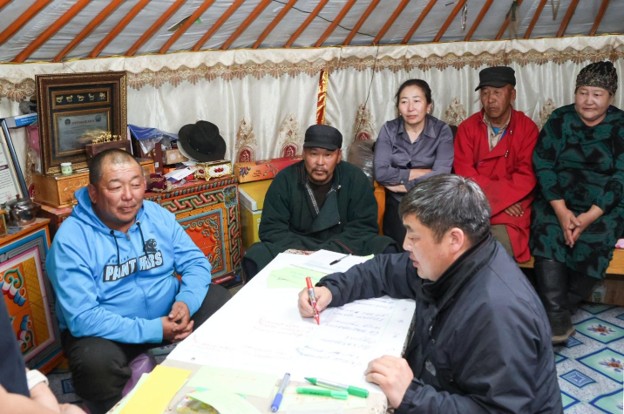
When Boldoo first introduced cash fines for lateness and disruptions at Bayanbulag CBO meetings, members were shocked and some were openly angry. Looking back, however, members now acknowledge that this firmness was transformative. As one UCC herder reflects: “At first we thought it was too strict. Now we would not want it any other way — nobody misses a meeting, everybody comes on time, and we get things done.” The culture of accountability that Boldoo built in Bayanbulag has become a model that other CBOs look to with admiration.
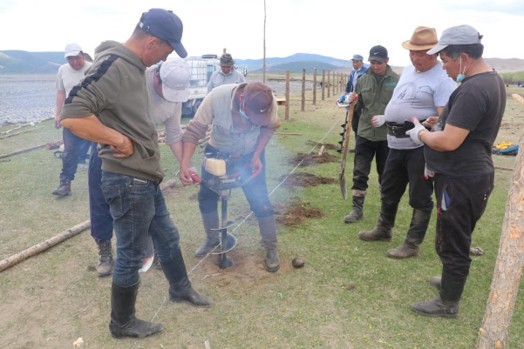
Community members also point to two tangible achievements as proof of what Boldoo’s leadership delivers. The fenced seedling regeneration area — now a thriving patch of forest providing hay in harsh winters — is frequently cited by UCC members as the most powerful demonstration that collective effort and patience bring real results. The communal reserve grazing area for weak and young livestock is equally praised as a practical, life-saving innovation during dzud conditions, rooted in traditional herder knowledge but realised through collective action.
Future Plans and Opportunities for Strengthening Work on Rangeland Restoration and Pastoralism:
As the UCC continues to grow — with several CBOs established as recently as 2023 — Boldoo’s immediate priority is to strengthen the capacity of newer member CBOs, particularly their Volunteer Rangers. He plans to work with local authorities and conservation NGOs to secure targeted training support for these VRs in SMART patrolling, biodiversity monitoring, and environmental law enforcement, ensuring that newer CBOs reach the same level of competence and confidence as the founding members.
Looking further ahead, Boldoo sees community-based ecotourism as a significant opportunity to diversify herder livelihoods while deepening appreciation for the KMGT landscape among wider audiences. The KMGT forest-steppe — with its stunning scenery, rich wildlife, and living nomadic culture — has strong potential to attract responsible tourists. To realize this, Boldoo is seeking funding support for two priorities: first, the construction of an LPA Information Center that would serve as a hub for welcoming visitors, hosting all-UCC meetings and community events, and showcasing the LPA’s conservation achievements; and second, training for UCC members in guest hosting, hygiene, safety, and the responsible management of tourist activities such as horse and yak riding.
A third and particularly significant plan relates to the recently approved Law on Unified Association of Herder Households (UHH), which grants important rangeland user rights as well as responsibilities to herder communities. Boldoo intends to study the new law carefully, explain its provisions and implications to all UCC members, and open discussions with the soum government on potential resource use contract arrangements. Should UCC members collectively approve, he plans to formally register the UCC as the Soum Union of Herder Households and develop a UHH resource management plan — a step that would give the community a legally recognized, long-term mandate over their rangeland and forest resources, cementing decades of collective conservation effort into a durable institutional and legal framework.
Boldoo envisions these three plans as interconnected: stronger ranger capacity protects the ecosystem, ecotourism generates sustainable livelihoods from it, and legal recognition under the UHH law secures the community’s rights over it for generations to come.
Photos and Video:
References:
1. Mr. Munkhtüvshin Nergui
Executive Director, Khoid Mogoin Gol Teel Union of Conservation Communities NGO
Address: Room 201, “Buman Useg” Printing Factory Building, Erdenebulgan soum, Arkhangai Province, Mongolia
Phone: +976 88076422
2. Mr. B. Batdorj
Acting Head, Arkhangai Province Environment Department
Address: 4th Bag, Erdenebulgan soum, Arkhangai Province 65133, Mongolia Tel/Fax: (976) 7033 3223
Email: arkhangaiboajg01@gmail.com