Name and Address:
Shri Sumer Singh Bhati
Village Sanwata, Post-Rasala, Tehsil-Fatehgarh, District Jaisalmer, Rajasthan, Pin Code-345001
Background information:
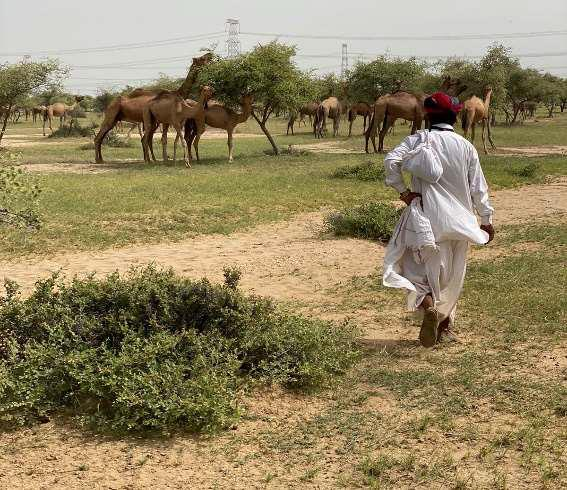
Mr. Sumer Singh Bhati s/o Bhanwar Singh, aged 45 years is a resident of village Sanwata in Jaisalmer District of Rajasthan. He is livestock keeper owning 200 Jaisalmeri camels, 15 Tharparkar cows, 100 Jaisalmeri sheep and 30 goats. He has inherited 16 hectares of land in which pearl millet, sorghum, green gram, moth bean, sesame, etc. are cultivated under rainfed conditions. Sumer Singh’s family is involved in livestock keeping. His forefathers were also primarily dependent on livestock over the last five generations.
Village background :
The village Sanwata under the Rasala Panchayat in Fatehgarh tehsil is 50 kilometres away from the Jaisalmer city, its district headquarters. The village has around 210 households. The average annual rainfall in the region is 150mm. Farmers are completely dependent upon the rainfall for cultivation of crops. There are no tubewells in the entire village. Since rainfall is low and erratic, crop production is uncertain and therefore, farmers are dependent on livestock rearing/ pastoralism for their livelihood since generations. The livestock is mostly dependent on grazing of commons. Further, this village is part of the Degarai Mata Temple Oran jurisdiction. This Oran (sacred groves) is one of the biggest orans in the country covering 20 villages under its jurisdiction. However, the Oran land in the Sanwata village was recorded as “Uncultivable waste land” under the revenue department records. Few practices or Traditional Knowledge associated with orans reported by locals that feeding of Sewan grass (Lasiurus Sindicus) to cows enhances the milk yield and quality. Baker grass is reported to be advantageous for camels. Applying the ash obtained by burning dry twigs of Kair (Capparis decidua) on camel’s body reduces and manages skin disease significantly.
Challenges & Problems faced in Rangeland and Pastoralism :
The state of Rajasthan, especially western part faces arid climate where rainfall is low and erratic. Droughts are recurrent phenomena and crop production is uncertain. Therefore livestock rearing has evolved as an adaptation strategy to cope with climate extremities in the region. Livestock rearing is an important source of livelihood for a large number of pastoralist and agri-pastoralist communities. The sustainability of this extensive pastoralism is dependent on natural grazing in community property resources (CPRs) found abundantly in the region. CPRs in western Rajasthan include Gauchars (grazing lands reserved exclusively for livestock grazing), Orans (sacred groves, which are rich in biodiversity and usually include a water body), Beers (grasslands for hay making), Agor (water catchment areas), Jorh or Tobas (village ponds), Ranns (saline depressions) and Khadins (crop cultivation under conserved moisture/ run-off farming). Traditionally, these commons were managed by the local communities. However, CPRs are facing severe degradation and encroachment since last few decades. Many of these commons are registered as “waste lands” or “uncultivable waste lands” in the revenue department records rendering these commons most vulnerable to diversion for non-agriculture development projects such as wind, solar and cement factories. These commons are allotted by state government to development projects further shrinking the area under commons. Transition from subsistence to commercial agriculture owing to increase in irrigation, access to better roads and markets has brought economic transition in the region.
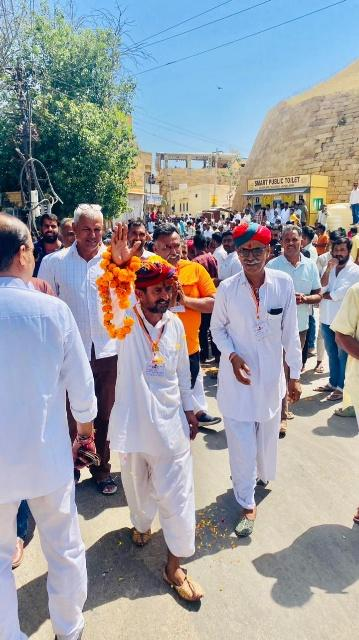
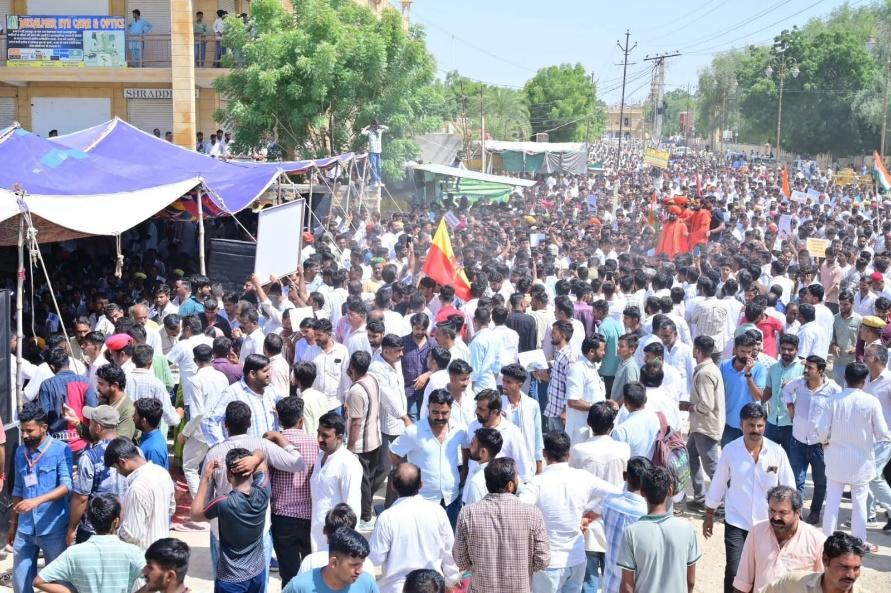
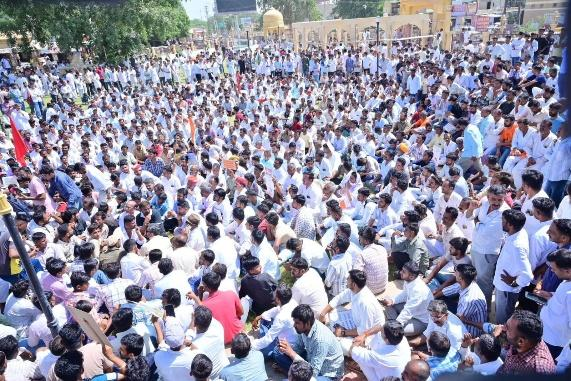
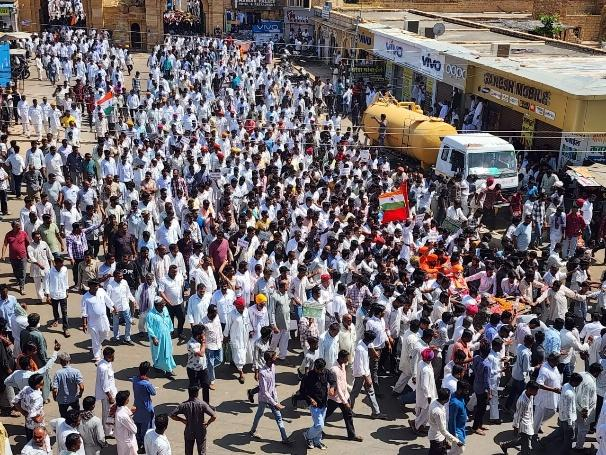
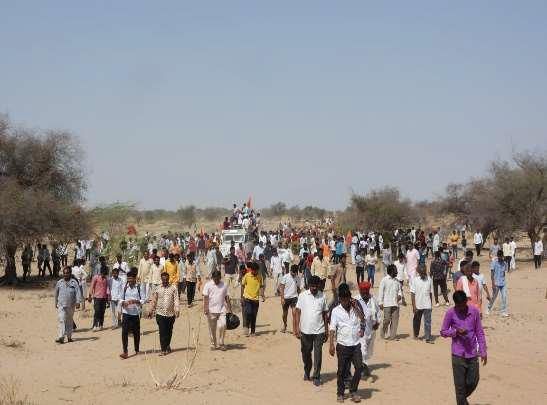
In response, the Oran team began their collective voice in 2018, rallying their community through awareness campaigns, peaceful marches, and the deeply spiritual act of parikrama/ circumambulation, around the threatened Orans. These symbolic journeys, often taken on foot across vast stretches of the Thar, serve as both a protest and a prayer as an appeal to the people, the government, and even the divine to preserve their sacred lands.
Role in Pastureland/Village Commons Development, Practices/Innovations
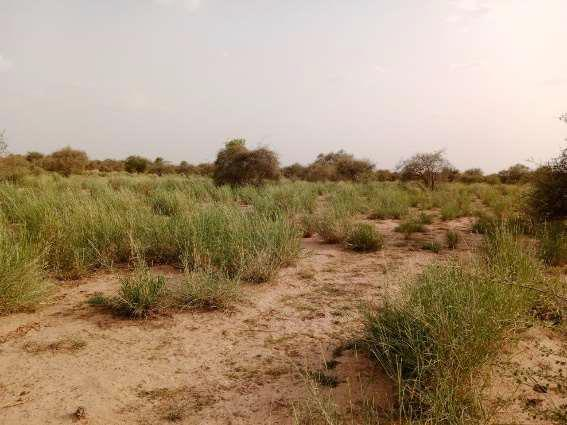
Around 20 villages, including Sanwata, are part of the Degarai Mata Temple Oran. It encompasses an area of approximately 10,000 ha dedicated to common property resources (CPR) and pastureland. The distinct demarcation of this significant area is marked by the presence of red cloth, symbolizing Mataji, tied around the trunks of the trees all along the boundary of the Oran. This unique and traditional boundary signifies the sanctity and protection of the land under the temple’s care. The Oran serves as a vital resource for grazing, enabling the well-being of livestock and, in turn, supporting the livelihoods of livestock herders in the region. Within the approximately 60 kilometer periphery of this Oran land, the livelihoods of about 5,000 families are intricately linked to the resources it provides. Approximately 50,000 cattle, 5000 camels and 50,000 small ruminants (sheep and goat) are dependent on the Oran for grazing. In Sanwata village alone, there are 7,000 cattle and 20,000 small ruminants.Various types of grasses such as Sewan grass (Lasiurus Sindicus), Dhaman grass (Cenchrus setigerus), Bur grass, Baker grass, Karad grass (Dichanthium annulatum), Bhurt grass (Cenchus biflorus) etc. are found in abundance. The abundance of these grasses underscores the biodiversity and natural fertility of the region, providing essential forage for the livestock. Oran also has spiritual and ecological significance for the community.
Retrieval and Management of Rangeland :
The Degarai Oran spans 10,000 hectares, some of which are under government jurisdiction and was allocated to companies. Sumer Singh realized that loss of these commons/ pasturelands will affect the livelihoods of farmers and pastoralists in the village. Since these pasturelands in the village were recorded as “Uncultivable waste land” under the revenue department records, these were subject to allotment by government to companies for different development projects in the future also.
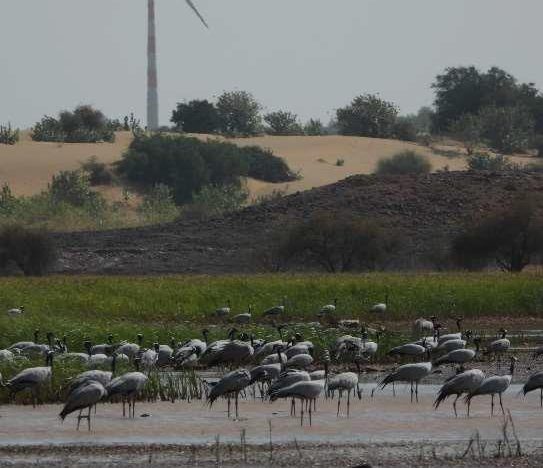
To prevent the diversion of Oran for other activities, Sumer Singh, along with the local community, tirelessly campaigned to restore the remaining land to Oran status. Sumer Singh mobilized public protests, engaged with the media, and advocated with local people and the government for the preservation of Oran and grazing lands. The National Green Tribunal (NGT) issued an order prohibiting the installation of high-tension power lines in the Oran, ensuring the protection of endangered bird species like the Great Indian Bustard (GIB), vultures and other wild life. As a result, approximately 600 hectares of land in Sanwata village were reinstated as Oran. Oran is managed and conserved by the local community and all have access to orans. Good practices such as prohibition of cutting and carrying of trees and grasses, restricted and rotational grazing are followed. These good practices are still practiced by the villagers and therefore, orans are in better conditions till date.Presently, due to Sumer Singh’s initiatives and with the involvement of the local community, these 10,000 hectares of land has undergone positive transformations. Pastures have been established, and strategically located ponds are now being constructed and maintained after every 5 kilometers within the Oran. This comprehensive approach reflects his commitment to environmental conservation, sustainable land use and the protection of diverse species in the region.
Impact and Feedback:
Mr. Sumer Singh’s dedicated efforts in safeguarding and maintaining the pastures within the Oran land have resulted in a positive impact on the livelihoods of the farmers and the ecology of the grasslands. His efforts have ensured that cattle herders have access to nutritious fodder for their livestock. As a direct outcome of these interventions, the number of cattle herders has increased significantly. Currently, approximately 50,000 livestock from around 20 villages graze in the Oran.
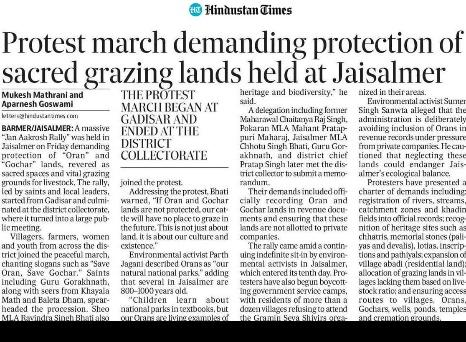
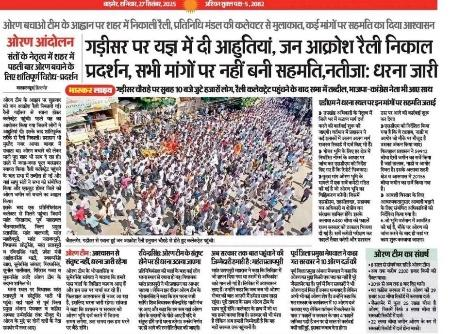
Oran Conservation Committee, a group of pastoralists, farmers, environmental activists and citizens in Jaisalmer district organized protests / hunger strike for 34 days during September 2025 in front of collector office,. One of their important demands is to register the Orans and Gauchars as such in the revenue department records. The team has undertaken Padayatra(walking by foot) in all villages of the district since last few years raising awareness among the pastoralists, farmers and the villagers. The protests have received wide support from public and people from all walks of life. The public representatives such as Member of Legislative Assembly(MLA) in the district too have supported the protest by the Oran team. The Oran team was assured that the commons including public properties will be surveyed and measures will be taken for their protection and conservation. The representations received from different villages for registration of Orans will be forwarded to the state government. It was decided that the survey will be undertaken on priority basis in those areas which are allotted for solar and cement factories. The Gram Panchayats and the public representatives will be involved in the entire survey process. With this, the Oran team has withdrawn their 34 day long protest. Sumer Singh Sanwta and Bhopal Singh from Oran team informed that both MLAs and district administration have assured that Orans will be registered in the revenue department records in three months.
The district administration has initiated the process of recording and surveying the commons in the district in official revenue records. The survey work is being undertaken in mission mode with the joint survey teams consisting of officials from revenue, irrigation and other departments. It is reported that administration has so far demarcated around 70,000 bighas ,( approximately 18,570 acres )of land across 47 villages and submitted the proposal to the state government for approval for recording in revenue department records. As Sumer Singh humbly puts it, “This is just the beginning. We are reclaiming not just land but our culture and our connection to nature.” The struggle to protect Orans is far from over, but with each registered plot, the community grows more hopeful. The story of the Oran team is a reminder of the power of unity, tradition, and the enduring human spirit to protect and cherish what is sacred, not just for themselves but for generations yet to come.
Oran Yatra 2026 (Foot March during Jan- April 2026 for 85 days) : The foot march, which spanned the distance from Jaisalmer to Jaipur, covered a total distance of approximately 700 kilometers. This pilgrimage was led by Mr. Sumir Singh. It commenced on January 21st, and the participants reached Jaipur on April 16th. More than 100 individuals—including farmers and livestock rearers—participated in this march. In Rajasthan, there are sacred groves (temple forests) located in approximately 25,000 different places. These lands have been officially recorded in government registers. Consequently, the government has stated that this protest must be called off. Within every temple forest, there are grazing lands ranging from 100 to 1,000 acres. Since these areas are not officially classified as grazing lands, they are being handed over to private companies for solar power projects. Consequently, livestock breeders who depend on these lands for their livelihood are facing severe hardships. Many are even abandoning their profession of camel herding. A *Padayatra* (foot march) is being conducted with the specific objective of ensuring that these grazing lands are officially recorded in government registers. Approximately 400,000 hectares of land currently exist as temple forests; there is a significant risk that these lands could be diverted for various government schemes.
The members of the protest group participating in this movement marched for 85 days to reach Jaipur. As a result of this protest, approximately 3,800 hectares of land have now been officially recorded in government registers.
The successful conversion of wasteland to Oran in Sanwata village was followed by 7-8 similar such cases in other villages. Further, villagers in Jaisalmer district have become aware and are protesting for similar cases in their villages/ regions.
Awards and recognition:
Shri. Sumer Singh has been awarded by various organizations for his role in conservation of commons and wild life. He was bestowed with Breed Saviour Award in 2017 by SEVA NGO, Madurai for conservation of Jaisalmeri camel breed. He received Girdhar Award by Jaisalmer Darbar and is also recognized by various government organizations including Government of Rajasthan, Collectorate of Jaisalmer, Narendra Dev University of Agriculture, Bikaner; Arid Forest Research Institute, Jodhpur; ICAR-National Research Center on Camel, Bikaner for his role in conservation of rangelands/ pasturelands, wild life and environment.
Way forward :
As an dedicated individual he has brought lot of oran lands(pasture lands/sacred groves) which are not classified /defined village records. Now his initiative is eye opener and opportunity that Government of Rajasthan to undertake this record updating . Supreme court judgment (No. 41723 of 2022) dated 18-12-2024 has upheld the ecological and cultural value of orans and emphasized on their protection as ‘deemed forests’. This coincides with the objectives of the International Year of Rangelands and pastoralist (IYRP) 2026 to protect the interests of lakhs of pastoralists and livestock keeping communities who critically depend on these resources. Therefore Government of Rajasthan look into the matter and discourage diversion of these lands as they are deeply embedded in the state’s socio-cultural fabric.
Picture of Activities: